Chains, Chipmunks, and Carnage: Why Angels Landing Might Be the Devil’s Favorite Hike


Once a Love-Ridge, Always a Loveridge
My last name is Loveridge, which implies that somewhere in the mists of genealogy, an ancestor squinted at a mountain skyline, felt romantic about it, and declared, “Yes, we are the people who love ridges.” I can’t prove this, but I also can’t disprove it, and frankly it’s the kind of logic I’m willing to embrace.
But on this night, standing in the dark on a narrow pirate plank of sandstone with 1,000-foot drop-offs on both sides, I wasn’t sure how much loving was going on. Admiring? Maybe. Respecting? Absolutely. Loving? Questionable.
Darkness has a way of making fear worse. Sure, you can’t see the dizzying plunge into oblivion, but that just leaves the imagination free to design its own death scenarios. And my imagination is obnoxiously creative when it comes to gravity-related accidents.
Here’s the thing: I’ve always had a “mild” fear of heights. Not the kind that keeps me from getting on a ladder to change a lightbulb, but the kind that makes my palms sweat like I’ve just shaken hands with a stick of butter. So in college, naturally, I took up mountaineering and rock climbing. Because that’s what sane people do—throw themselves at the very thing they’re afraid of, but with ropes. I learned two things: one, climbing is fun; and two, fear of heights doesn’t go away. It just becomes a loud but manageable roommate in your brain.
I’ve visited Zion National Park countless times, but I’ve always skipped the last terrifying bit of Angels Landing—the infamous chains section. Why? Because it’s always a zoo. Imagine ants, but human-sized, marching in and endless single-file parade, up the cliff. Within the first hundred yards, there’s inevitably someone plastered against the rock, clutching the chain like it’s their childhood teddy bear, bawling uncontrollably. It’s a mosh pit of panic, and I’ve never had any desire to join.
Still, a voice in the back of my head keeps needling me: Mike, this is supposed to be the most dangerous hike in America. You’re a ridge-loving Loveridge. How do you not finish this thing? And then, it throws in a parting jab: What are you, a big baby?
Einstein with a Headlamp
Then a plan lodged itself in my brain—one of those ideas that feels so clever you want to build a statue of yourself just for thinking it up.
Step one: permits. The Park Service now requires them, which means the number of terrified humans clinging to the chains is capped. Good start.
Step two: buses. You can’t just drive to the trailhead anymore; you have to ride a shuttle. First one leaves at 6 a.m. That smelled like opportunity.
Step three: my shiny new e-mountain bike. Top speed: 28 mph. See where I’m going with this?
Now, I did get a minor in math in college (which mostly meant I knew how to calculate how many slices of pizza could be divided among three roommates before a fight broke out). But this one was easy:
Wake up: 4:00 a.m.
Bike to the trailhead by headlamp: 4:30–5:00.
Start hiking: 5:15, in the dark, glowing like coal miners.
Haul it up the Wiggles.
Hit the chains by 5:55.
Thirty minutes to the top.
Thirty minutes of sunrise glory.
Thirty minutes back down before the first wave of caffeinated speed-hikers arrives around 7:00.
In my mind, this plan sparkled with Einstein-level brilliance. Honestly, it was E=mc², but with sweat and bike grease.
Did it work? Did I, in fact, hack Zion National Park with the help of a headlamp and some middle-school arithmetic? Stay tuned.
The Preacher Who Couldn’t Stop Naming Things
In 1858, Mormon pioneers settled near the mouth of the canyon, where Springdale sits today. They learned that the local Paiute people called the gorge Mukuntuweap, roughly meaning “straight canyon” or “straight-up land.” (Accurate. Not flashy. The Paiute were not running a tourism bureau.)
Within a few years, however, the settlers, with Bibles practically in their tool belts, started calling it Zion Canyon. In their scriptures, Zion meant a holy refuge, a promised land, or a community of the faithful. One look at those cathedral-like sandstone walls, and the name stuck like gum under a pew.
By the 1860s, Zion Canyon was the go-to name, and it had so much traction that when Mukuntuweap National Monument was redesignated as a full-fledged national park in 1919, the biblical branding won the day: Zion National Park.
Then came Frederick Vining Fisher, a Methodist minister touring Zion in 1916. He looked up at a sandstone spine so tall and skinny it seemed to spear the clouds, and declared:
“Only an angel could land on it.”
And with that, Angels Landing was christened. Fisher, pleased with himself (and who wouldn’t be after naming something so quotable?), kept going. He became Zion’s unofficial hype man, cranking out names with the enthusiasm of a Sunday school teacher armed with a labeling gun:
The Great White Throne – God’s throne, but in sandstone.
The Organ – Because it looked like a giant church organ.
The Temple of Sinawava – A nod to the Paiute wolf god, blended into Fisher’s biblical framework.
The Altar of Sacrifice – Red streaks on the cliffs reminded him of Old Testament blood sacrifices.
The Pulpit – A rock pillar he figured looked just like, well, a pulpit.
Fisher wasn’t just naming rocks—he was staging a revival. He wanted visitors to see Zion as a stone cathedral, a place where God’s architecture was both intimidating and sublime. The National Park Service later adopted many of his names, and to this day they shape how people imagine the canyon: not just geology, but scripture in sandstone.
But here’s the kicker: Fisher named Angels Landing, but never climbed it. My hunch? If he had actually crawled up that sandstone spine himself, sweaty palms on the chains, he might have chosen something less angelic and more honest. Something like “Terrifying Sandstone Spike of Doom.”

When Trails Go to Hell
Before I explain why “Angels Landing” might not be the most accurate name in the world, let’s take a quick detour into the celestial naming business.
When I searched for trails, rivers, rapids, and climbs with “angel” in the name, I found… not much. There’s Angel Falls in Venezuela, Bright Angel Trail in the Grand Canyon, and Dark Angel, a sandstone pillar in Arches. That’s about it. Angels don’t seem to get around much when it comes to topographic adventure branding.
Now flip the script and type in “devil,” “Satan,” “Diablo,” or “Lucifer.” Suddenly, the outdoors becomes one giant demonic theme park. Devil’s Garden. Devil’s Path. Devil’s Backbone. Devil’s Hole. Devil’s Elbow. Devil’s Tower. Devil’s Canyon. Devil’s Punchbowl. Satan’s Gut. Diablo Falls. It goes on and on, as if the underworld had its own Chamber of Commerce and a very aggressive marketing budget. There are hundreds… even thousands of hits.
The pattern is obvious: Angel = good, safe, uplifting. Devil = bad, dangerous, probably the sort of place where your mother warned you not to play. Which makes me wonder… how exactly did a place as nerve-shredding as Angels Landing end up with the good-guy name?

Morticians Make the Worst Motivational Speakers
The alarm went off at 4:30 a.m., and soon Leslie and I were pedaling down the middle of the Zion Canyon Scenic Drive. Scenic, yes, but in a shadowy, slightly-haunted kind of way. Our headlamps threw light across trees, rocks, and other shapes that may or may not have been plotting against us. Above, the stars put on a private twinkly fireworks show. The only sounds: the whine of knobby mountain bike tires and the soft hum of electric motors, which somehow made us feel quite content despite the early hour.
By 5:15 we had the bikes parked at the Grotto Picnic Area, locks on, and were bounding up the trail like caffeinated mountain goats. Icebox Canyon was silent except for our breathing. We passed the sign begging hikers to keep quiet so as not to disturb the owls, who I assume were glaring at us anyway. Then came Walter’s Wiggles: 25 tight little switchbacks stacked like a Slinky trying to escape down the mountain.
It was 60 degrees—perfect. I knew that later, hikers would be frying themselves in 90-degree heat, slowly transforming into rotisserie chickens.
We reached the chains in just 40 minutes. Quick water break, then onward into the unknown. Leslie had done this as a kid. I’d never touched it. All I had were secondhand horror stories—like those from Leslie’s brother, a mortician in nearby St. George. He told us that when people fall here, they often look intact on the outside while their insides have turned to pulp. Not exactly the motivational pep talk we had hoped for.
The chains are there… except when they’re not. In the dark, those gaps turned into navigation puzzles. Every time I thought about the 1,000-foot drop-offs, panic flirted with me. Breathe, focus, keep moving. That was the mantra. The wind gusted; I prayed it wouldn’t gust harder. Leslie charged ahead, her headlamp bouncing like a firefly up the sandstone spine. Every so often I stopped—not because I needed to, but because the stars overhead were just that good, and because the horizon was quietly hinting at dawn.
But the thought kept returning: Loveridge, this is way gnarlier than you ever imagined. How is this legal? How do they just let anyone do this? This is insane.
It felt less like a U.S. National Park and more like one of those “safety third” adventures you hear about in developing countries, where the government shrugs and lets natural selection do its thing. America usually child-proofs every corner of nature with ropes, railings, and warning signs. This? This was raw, precarious, dangerous… and thrilling.
I was even having fun—at least in between doses of ibuprofen. I popped them like Halloween candy, a little gift to the arthritis in my feet, ankles, and knees. Years of marathons, heaving backpacks, and various extreme sports had taken their toll. (And no, sadly, I can’t say it was from karate-chopping stacks of boards. My alibi is much less glamorous.)
Heaven With a Side of Chipmunks
And then — we were there. The summit. 6:15 a.m. Flat one hour. Smokin’ fast.
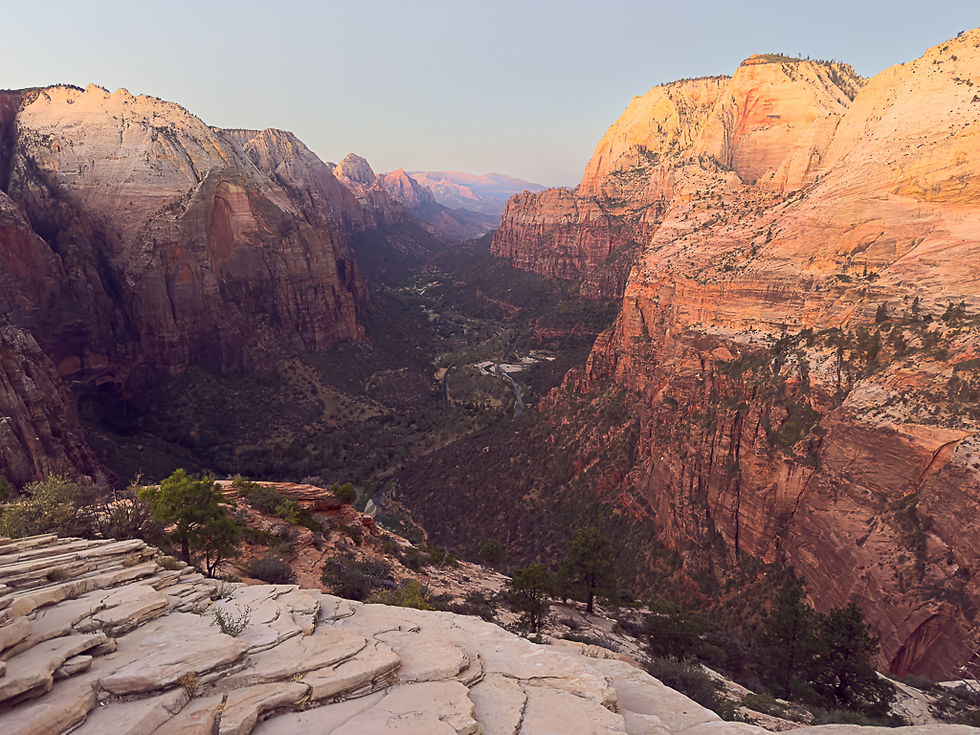
The valley was waking up in technicolor. Down below, I saw the faint headlights of the very first shuttle bus of the day crawling up the road. I grinned: those poor hikers down there were just lacing their boots, while we were already perched 1,500 feet above them, smugly victorious.
And it was gorgeous. All of it. Everywhere.
Leslie glowed in the first light — she was the real angel on Angels Landing. Which was fitting, because this perch was celestial… though honestly, given the hike to get here, the name could have used a little devil branding. Devil’s Stairmaster, maybe.
The wind, which had bullied us the whole climb, went suddenly still, like it knew it had lost.
The colors poured in: Paiute turquoise, butterfly yellow, brook-trout pink. The cliffs gleamed in metallic shades — pumpkin orange, maroon, mountain goat-milk chocolate, like someone had stirred molten mercury with a painter’s brush.
We had 30 minutes, and we used every one. Snapping photos. Spinning in circles. Trying desperately to cram infinity into an iPhone photo. Spoiler: you can’t.
Then the chipmunks showed up. And when Leslie started photographing chipmunks more than cliffs, I knew the moment had passed. Time to go.
The descent was faster, scarier, and suddenly much more revealing. In the daylight I could clearly see where, in the dark, we had made what I would politely call “questionable decisions.” This ridge felt like the epicenter of midlife crises — the place where they are born, tested, and buried.
To amuse myself, I invented a little game: every stray thought had to be followed with “…and then he fell and died.”
“Wow, what a view… and then he fell and died.”
“This chain feels solid… and then he fell and died.”
“I could go for pancakes… and then he fell and died.”
I thought it was hilarious. Which probably says something disturbing about me.
Meanwhile, Leslie calmly filmed the entire descent, presumably so posterity would someday know the exact moment we “…fell and died.”
Angels Landed in a Zombie Hoard
We exited the chains just as the first five hikers of the day started up. Our timing was perfect. I grinned smugly. Leslie grinned smugly. We had matching smugness, which is the rarest and most satisfying kind.
Those first five hikers looked intense — fit, focused, early-rising overachievers. The cream of the canyon crop. But as we descended farther, the parade swelled. Dozens, then seemingly hundreds, all trudging upward. The further down we went, the less “elite athlete” they looked and the more “surprised Walmart shopper who took a wrong turn.” It was like watching competence dissolve in real time.
I shook my head. The Park Service lets anyone climb this thing? No waivers? No helmets? No psych evals? Madness. But not my circus. Not my chains.
By the lower switchbacks, I’d given up saying “Good morning” to every hiker we passed. Too many. My cheery greetings had devolved into polite head nods — a universal language men especially seemed to appreciate. Silent acknowledgment. Minimal effort. Everyone wins.
Finally, back at our e-bikes, we mounted up and coasted down-canyon. The breeze whistled through my helmet hair, the cliffs rose around us in silent applause, and all was well. Content. Satisfied. It was the perfect start to a day that already felt like a victory lap.


Comments